


Best Productivity Software in 2026 | Top Tools to Boost Efficiency
Productivity software has become the backbone of modern work in 2026. Whether you run a business, manage remote teams, freelance, or study online, the right tools help you stay organized and efficient. From task management to AI-powered automation, these platforms save time and reduce manual effort. Companies now focus on smarter workflows instead of harder work. With digital collaboration becoming standard, productivity software is no longer optional; it is a strategic investment for improving performance, reducing stress, and helping individuals and teams achieve better results every day.
What is Productivity Software?
Productivity software refers to digital tools designed to help individuals and teams complete tasks faster, manage projects better, and improve daily workflow efficiency. These tools include task managers, note-taking apps, communication platforms, scheduling systems, and automation software. Their main purpose is to reduce wasted time and improve focus. In 2026, productivity software will also include AI assistants that handle repetitive work, generate summaries, and support decision-making. These solutions help businesses create smoother operations while allowing users to work with more clarity and less distraction.
Key Features to Look for in Productivity Software
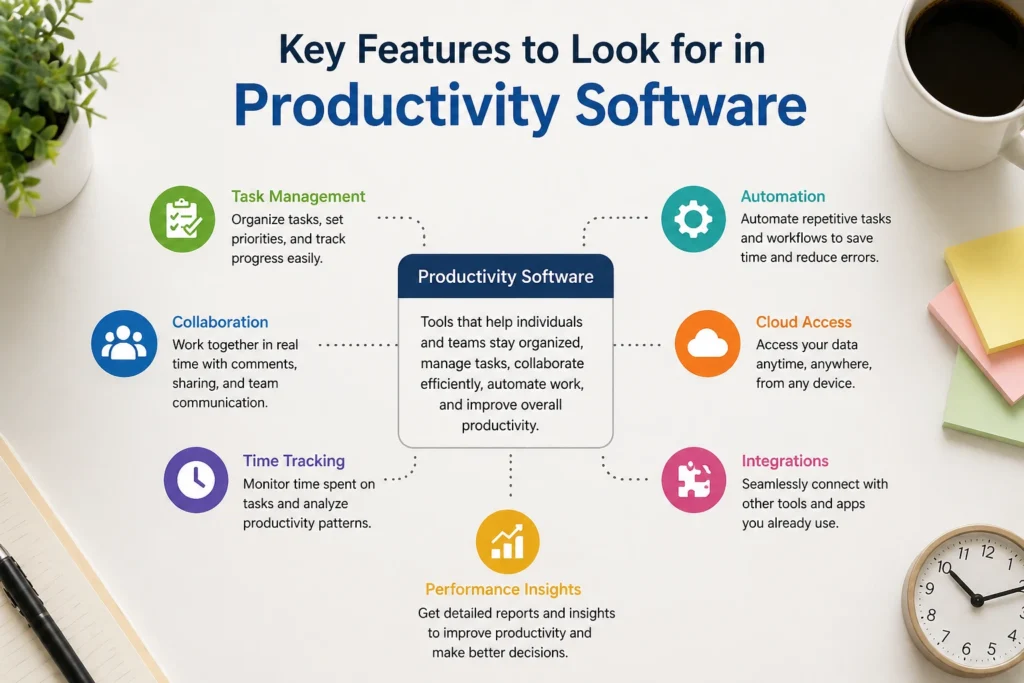
Choosing the right productivity software requires understanding the features that truly improve workflow. Task management helps organize priorities, while collaboration tools support faster communication across teams. Automation features reduce repetitive work and improve consistency. Time tracking provides useful insights into daily performance and efficiency. Cloud access ensures flexibility across devices and locations. AI-powered recommendations are also becoming essential in 2026. The best productivity platforms combine these features into one seamless experience, helping users stay focused, meet deadlines, and maintain better control over personal and professional responsibilities.
👉 You might also like: Internet Chicks: Digital Strategy, Branding & Monetization
Task Management and Project Tracking
Task management allows users to create, assign, and monitor work without confusion. Project tracking features help teams follow deadlines, milestones, and progress in real time. This improves accountability, reduces missed tasks, and keeps every project moving smoothly from planning to completion.
Collaboration and Communication Features
Strong collaboration tools make teamwork faster and more efficient. Features like shared workspaces, instant messaging, comments, and file sharing improve communication across departments. In remote and hybrid workplaces, these tools help teams stay connected, aligned, and productive without unnecessary delays or misunderstandings.
Time Tracking and Performance Insights
Time tracking helps users understand where their hours are spent and where productivity is lost. Performance insights reveal patterns, distractions, and improvement opportunities. This helps professionals and businesses make smarter decisions, improve focus, and build more effective daily work habits.
How We Selected the Best Productivity Software in 2026
To identify the best productivity software in 2026, we focused on tools that deliver real value across different work environments. We analyzed usability, performance, integrations, pricing, customer support, and scalability. We also considered AI capabilities, mobile accessibility, and team collaboration features. Software that supports both individuals and growing businesses ranked higher. User reviews and industry reputation also played an important role in the evaluation. Our goal was to highlight platforms that not only look impressive but genuinely improve workflow efficiency and long-term productivity outcomes.
Evaluation Criteria Used for Ranking
We reviewed each platform based on ease of use, feature depth, reliability, customer satisfaction, and flexibility. Tools with strong AI support, smooth integrations, and scalable plans received better rankings because they offer long-term value for both individuals and teams.
Pricing, Usability, and Integration Standards
Affordable pricing matters, but value matters more. We compared free and paid plans based on the features offered. Easy-to-use interfaces and strong integration with tools like email, calendars, CRM systems, and cloud storage were essential for selecting top-performing productivity software.
Best Productivity Software in 2026 – Quick Comparison Perspective
Before diving into individual tools, it’s important to understand that no single productivity software fits everyone. In 2026, most platforms are designed for specific workflows such as project management, communication, automation, or personal task handling. Some tools focus on all-in-one functionality, while others specialize in one area and do it extremely well. The best choice depends on your team size, budget, and daily workflow needs. Modern users now prefer flexible ecosystems that integrate easily instead of rigid standalone systems that limit productivity growth.
Notion – All-in-One Productivity Workspace
Notion has become one of the most flexible productivity platforms in 2026 because it combines notes, databases, tasks, and project management in a single workspace. Users can fully customize dashboards based on personal or team needs. It works well for individuals, startups, and even enterprise teams that want centralized knowledge management. With AI-powered writing and organization features, Notion reduces manual documentation work. Its biggest strength is adaptability, allowing users to build their own productivity system instead of following a fixed structure.
Key Features of Notion
Notion offers customizable pages, databases, task boards, and real-time collaboration. Users can create workflows, manage projects, and store knowledge in one place. Its AI assistant helps generate content, summarize notes, and automate repetitive writing tasks efficiently.
Pros and Cons of Notion
Notion is highly flexible and powerful, but it can feel overwhelming for beginners due to its customization options. While it replaces multiple tools, it requires setup time to unlock its full potential. Once configured, it becomes extremely efficient for long-term productivity.
Asana – Structured Project Management for Teams
Asana is widely used for structured project management where clarity and deadlines matter. It helps teams break down complex projects into manageable tasks with clear ownership. In 2026, Asana continues to focus on workflow transparency and accountability. Managers can track progress easily, while team members understand exactly what needs to be done. It is especially useful for mid-size and large teams working on multiple projects simultaneously, where organization and visibility are critical for success.
Why Teams Prefer Asana
Teams prefer Asana because it reduces confusion in project execution. It provides clear task assignments, progress tracking, and timeline views. This structure helps improve accountability and ensures that everyone stays aligned with project goals and deadlines.
Trello – Visual Task Management Made Simple
Trello remains a popular choice for users who prefer visual organization. It uses boards, lists, and cards to manage tasks in a simple drag-and-drop interface. In 2026, Trello is still valued for its simplicity and ease of use, especially for small teams and individuals. It works best for lightweight project tracking rather than complex workflows. With Power-Ups and integrations, users can extend its functionality without losing its core simplicity and visual clarity.
ClickUp – Advanced All-in-One Productivity Platform
ClickUp has evolved into one of the most feature-rich productivity platforms available in 2026. It combines task management, docs, goals, time tracking, and automation in one system. It is designed for teams that want full control over their workflow without switching between multiple apps. ClickUp is highly customizable and supports different productivity styles, making it suitable for startups, agencies, and enterprise teams that need scalability and advanced workflow automation.
Monday.com – Visual Work Operating System
Monday.com is known for its visually appealing interface and strong workflow management capabilities. It allows teams to plan, track, and execute projects in a highly structured environment. In 2026, it is widely used for business operations, marketing campaigns, and project coordination. Its strength lies in automation and customization, helping teams reduce manual work while maintaining full visibility over progress and performance across departments.
Why Monday.com Stands Out
Monday.com stands out because it combines visual simplicity with powerful automation. Teams can build custom workflows, automate repetitive tasks, and track progress in real time. This balance of design and functionality makes it a strong choice for businesses that value clarity and efficiency.
Slack – Real-Time Team Communication Hub
Slack continues to dominate team communication in 2026 by offering organized, real-time messaging channels. It reduces email dependency and improves collaboration across departments. With integrations for thousands of tools, Slack becomes a central communication hub for modern teams. It is especially useful for fast-moving organizations where quick decision-making and instant communication are essential for productivity and teamwork efficiency.
Microsoft Teams – Enterprise Collaboration and Communication Platform
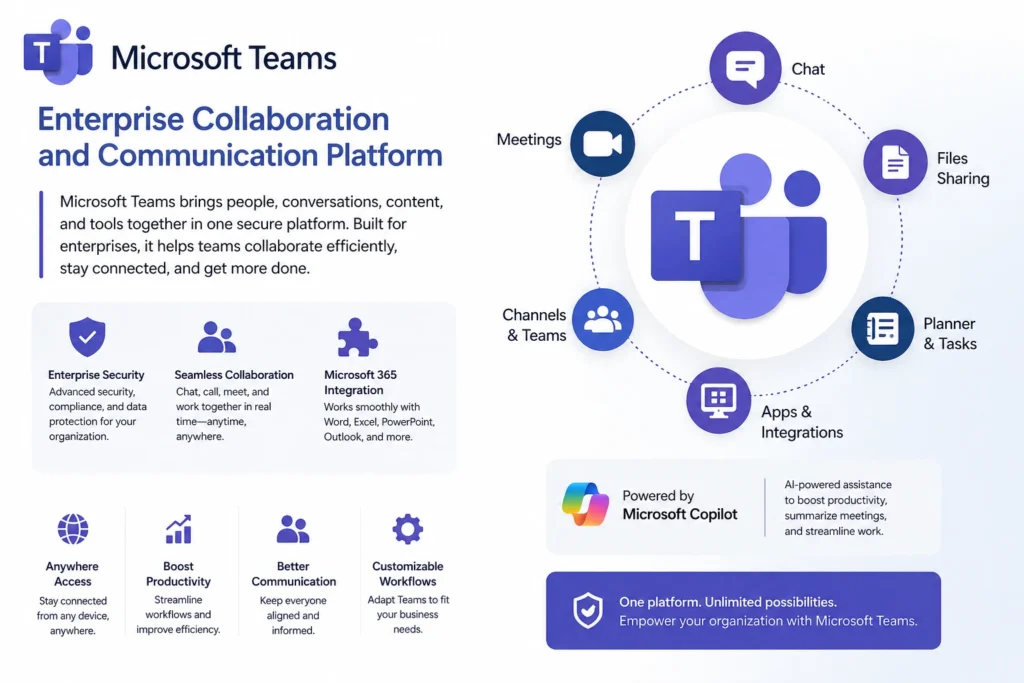
Microsoft Teams remains one of the most powerful productivity platforms in 2026, especially for large organizations and enterprises. It combines chat, video meetings, file sharing, and deep Microsoft 365 integration into one unified system. Teams helps companies centralize communication and reduce dependency on scattered tools. With AI-powered meeting summaries, real-time collaboration on documents, and strong security controls, it supports structured enterprise workflows. It is particularly effective for organizations that already rely on Microsoft ecosystem tools and need a scalable communication and collaboration solution.
👉 You might also like: How Classroom 30x Is Changing Student Learning in 2026
Todoist – Simple Yet Powerful Personal Productivity Tool
Todoist is designed for individuals who want clean and distraction-free task management. In 2026, it continues to be a favorite among freelancers, students, and professionals who prefer simplicity over complexity. Users can quickly create tasks, set priorities, and organize daily workflows without learning a complicated system. Its smart scheduling and recurring task features help users stay consistent. Todoist focuses on personal productivity rather than team collaboration, making it ideal for people who want to manage their own time more effectively and maintain strong daily discipline.
Google Workspace – Cloud-Based Productivity Ecosystem
Google Workspace is a complete cloud productivity ecosystem that includes Gmail, Docs, Sheets, Drive, and Meet. In 2026, it remains a top choice for businesses and teams that need real-time collaboration and seamless cloud access. Multiple users can work on documents simultaneously, making teamwork faster and more efficient. Its integration across apps creates a smooth workflow experience for communication, storage, and content creation. Google Workspace is especially valuable for remote teams that need flexibility, reliability, and instant access to shared resources from any device.
Microsoft 365 Copilot – AI-Powered Productivity Suite
Microsoft 365 Copilot represents the future of AI-driven productivity software in 2026. It integrates directly into Word, Excel, Outlook, and Teams to assist users with writing, analysis, and automation. Copilot can generate reports, summarize emails, and even create presentations based on simple prompts. This reduces manual effort and significantly improves workplace efficiency. It is designed for professionals and enterprises that want to leverage AI to save time and make better decisions. Copilot transforms traditional office software into an intelligent productivity assistant.
Zapier – Workflow Automation Without Coding
Zapier is a leading automation tool that connects different apps and automates repetitive tasks without any coding skills. In 2026, businesses use Zapier to streamline workflows between CRM systems, email platforms, spreadsheets, and project management tools. It helps eliminate manual data entry and improves operational efficiency. Users can create automated workflows called “Zaps” that trigger actions across multiple applications. This makes Zapier extremely valuable for businesses that rely on multiple software tools and want to reduce time spent on repetitive tasks.
Calendly – Smart Scheduling and Time Management Tool
Calendly simplifies scheduling by eliminating the need for back-and-forth emails. Users can share their availability, and others can book meetings automatically based on open time slots. In 2026, it will be widely used by professionals, freelancers, and sales teams to manage meetings efficiently. It integrates with calendars like Google and Outlook, ensuring real-time updates and conflict-free scheduling. Calendly improves productivity by reducing time wasted on coordination and helping users focus more on actual work instead of managing appointments.
Evernote – Advanced Note-Taking and Knowledge Management
Evernote continues to be a strong tool for capturing ideas, organizing notes, and managing personal knowledge. In 2026, it will offer improved search features, AI-assisted note organization, and better cross-device syncing. Users can store text, images, voice notes, and documents in one place. It is especially useful for researchers, writers, and professionals who need structured information storage. Evernote helps users turn scattered ideas into organized knowledge, making it easier to retrieve and use information when needed.
RescueTime – Focus and Time Tracking Optimization Tool
RescueTime is designed to help users understand and improve how they spend their time. It runs in the background and tracks digital activity to provide detailed productivity reports. In 2026, it helps professionals identify distractions, improve focus, and build better work habits. Users can set productivity goals and receive alerts when they spend too much time on non-productive activities. RescueTime is especially useful for remote workers and freelancers who want better control over their daily productivity patterns.
Miro – Visual Collaboration and Brainstorming Platform
Miro is a powerful visual collaboration tool used for brainstorming, planning, and designing workflows. It provides an infinite digital whiteboard where teams can collaborate in real time. In 2026, Miro is widely used by product teams, designers, and remote teams for mapping ideas and strategies. It supports diagrams, sticky notes, and templates that simplify complex planning. Miro improves creativity and teamwork by making abstract ideas more visual and easier to understand across distributed teams.
Conclusion
The best productivity software in 2026 depends entirely on your workflow, team size, and goals. Some tools are designed for personal task management, while others focus on enterprise-level collaboration or AI-powered automation. Instead of relying on a single platform, most users now combine multiple tools to build a complete productivity ecosystem. The key is to choose software that reduces complexity, improves focus, and integrates smoothly with your daily work routine.
FAQs – Best Productivity Software in 2026
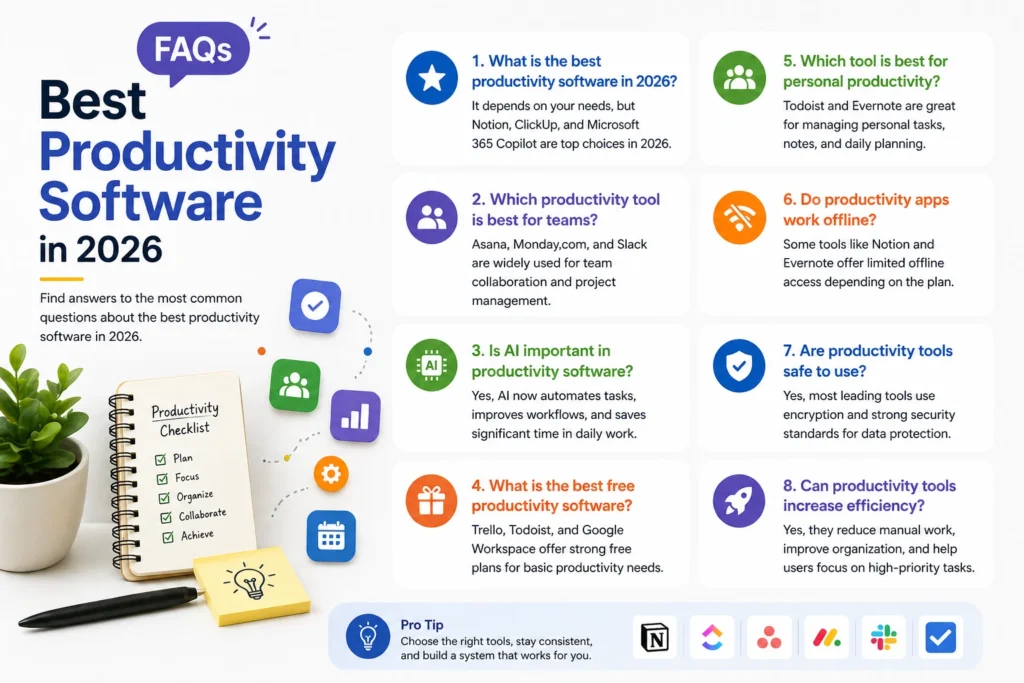
What is the best productivity software in 2026?
The best software depends on your needs, but Notion, ClickUp, and Microsoft 365 Copilot are top choices in 2026.
Which productivity tool is best for teams?
Asana, Monday.com, and Slack are widely used for team collaboration and project management.
Is AI important in productivity software?
Yes, AI now automates tasks, improves workflows, and saves significant time in daily work.
What is the best free productivity software?
Trello, Todoist, and Google Workspace offer strong free plans for basic productivity needs.
Can productivity tools increase efficiency?
Yes, they reduce manual work, improve organization, and help users focus on high-priority tasks.
Which tool is best for personal productivity?
Todoist and Evernote are great for managing personal tasks, notes, and daily planning.
Do productivity apps work offline?
Some tools, like Notion and Evernote, offer limited offline access depending on the plan.
Are productivity tools safe to use?
Yes, most leading tools use encryption and strong security standards for data protection.
✨ Got value? Let’s keep the momentum, follow Dympigal