

Best AI Tools for Small Businesses in 2026 | Top AI Software Guide
Artificial intelligence has become one of the most valuable investments a small business can make in 2026. What was once considered enterprise technology is now accessible, affordable, and practical for businesses of all sizes. AI tools help small businesses automate repetitive tasks, improve customer experiences, create content faster, and make better business decisions with fewer resources. According to the U.S. Chamber of Commerce, nearly 60% of small businesses now use generative AI, a significant increase from previous years. This guide explores the best AI tools available today and helps you identify which solutions can deliver the greatest impact for your business.
What Are AI Tools for Small Businesses?
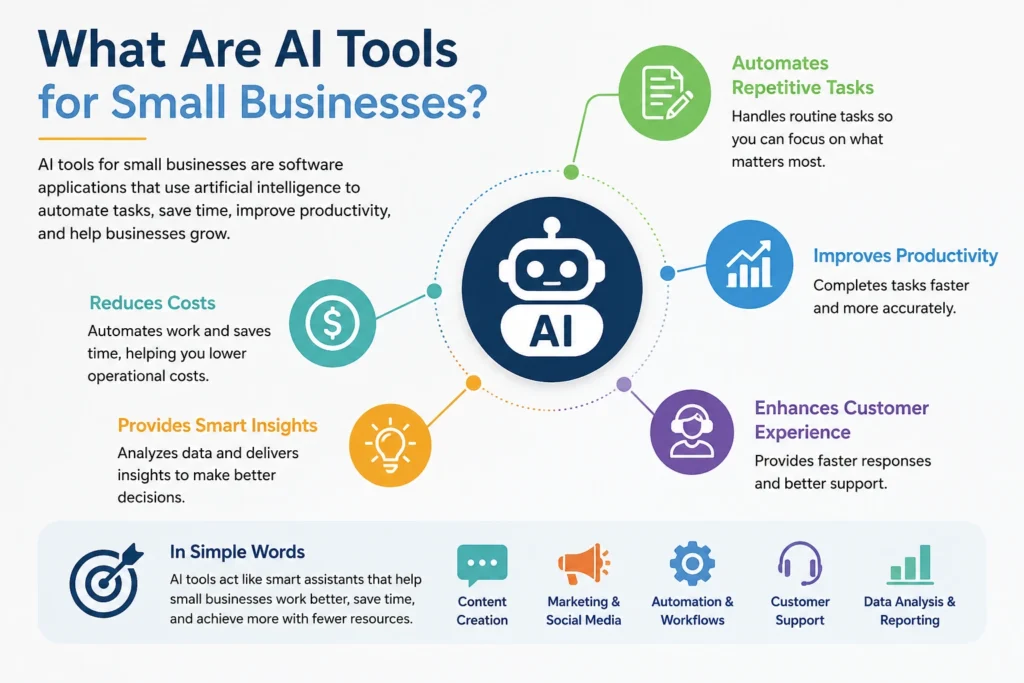
AI tools for small businesses are software platforms that use artificial intelligence to automate workflows, enhance productivity, and improve decision-making. These tools can assist with marketing, customer support, content creation, research, accounting, project management, and business operations. Unlike traditional software, modern AI platforms learn from user behavior and provide intelligent recommendations that help businesses work more efficiently. Recent research suggests that strategic AI adoption can reduce operational costs by up to 30% while increasing productivity and business performance, making AI an essential competitive advantage for growing companies.
👉 You might also like: Best Freelancing Platforms in 2026 | Top Freelance Job Sites
Why Small Businesses Need AI Tools
Small businesses often face challenges related to limited budgets, small teams, and increasing customer expectations. AI tools help overcome these challenges by automating repetitive work, reducing operating costs, and allowing teams to focus on higher-value activities. Whether it’s creating marketing campaigns, managing customer relationships, or automating business workflows, AI can significantly improve efficiency. Recent industry reports show that AI adoption among small businesses continues to accelerate because owners increasingly recognize its ability to save time, improve productivity, and support sustainable business growth in competitive markets.
Key Features of the Best AI Tools
Automation and Productivity
The most valuable AI tools automate repetitive and time-consuming business tasks. Features such as workflow automation, content generation, intelligent assistants, and task management help small businesses save hours of manual work every week. Businesses that successfully implement AI automation often improve productivity while reducing operational expenses, allowing employees to focus on strategic activities that directly contribute to growth and customer satisfaction.
Integrations and Scalability
An AI platform is only as useful as its ability to integrate with existing business systems. The best AI tools connect seamlessly with CRM software, email marketing platforms, accounting systems, project management tools, and communication applications. Strong integration capabilities allow businesses to build scalable workflows that grow alongside their operations without requiring major technology investments.
Pricing and ROI
For small businesses, affordability and return on investment remain critical factors when selecting AI software. The best AI tools provide flexible pricing options, free plans, and measurable business outcomes. Many companies begin with one or two AI solutions and expand their technology stack after seeing improvements in efficiency, revenue growth, and operational performance.
Best AI Tools for Small Businesses
ChatGPT
ChatGPT has become one of the most widely used AI tools for small businesses because of its versatility and ease of use. Business owners use it for content creation, customer communication, brainstorming, market research, documentation, and workflow optimization. Its ability to handle multiple business functions makes it an affordable and highly effective productivity tool for companies with limited resources.
Jasper AI
Jasper AI is a leading AI writing platform designed primarily for marketing teams, agencies, and content creators. It helps businesses generate blog posts, advertising copy, email campaigns, social media content, and branded messaging quickly and consistently. Its brand voice capabilities and marketing-focused features make it particularly valuable for businesses investing heavily in digital marketing strategies.
Perplexity AI
Perplexity AI has emerged as one of the best research tools for entrepreneurs and small business owners. Unlike traditional search engines, it provides conversational answers supported by citations and verified sources. This allows businesses to conduct research faster, validate information more effectively, and make better strategic decisions based on reliable and current data.
Canva Magic Studio
Canva Magic Studio enables small businesses to create professional visual content without requiring advanced design skills. Its AI-powered features include image generation, design assistance, presentation creation, and brand management tools. These capabilities allow businesses to produce high-quality marketing materials quickly while reducing the need for external design services.
Notion AI
Notion AI combines project management, documentation, collaboration, and artificial intelligence within a unified workspace. Small businesses use it to organize information, summarize meetings, generate content, and improve team productivity. Its flexibility and integration capabilities make it an effective solution for companies seeking a centralized knowledge management system.
Zapier AI
Zapier AI helps small businesses automate workflows across thousands of applications without requiring programming knowledge. By connecting business tools and automating repetitive processes, companies can reduce manual work, improve efficiency, and scale operations more effectively. It remains one of the most practical automation platforms available for growing businesses.
HubSpot AI
HubSpot AI integrates artificial intelligence into customer relationship management, marketing automation, sales processes, and customer service operations. Small businesses benefit from intelligent lead management, automated customer interactions, predictive insights, and improved marketing performance. Its all-in-one ecosystem makes it especially attractive for companies focused on growth.
Tidio AI
Tidio AI provides small businesses with AI-powered chatbots and customer support automation tools. These features allow companies to deliver instant responses, capture leads, answer common questions, and provide customer support around the clock. This improves customer satisfaction while reducing support costs and operational complexity.
Otter.ai
Otter.ai simplifies business meetings by automatically generating transcripts, summaries, action items, and meeting notes. This helps teams save time, improve collaboration, and maintain accurate records of important discussions. For remote and hybrid businesses, Otter.ai has become a valuable productivity tool that reduces administrative workload.
Gamma AI
Gamma AI allows businesses to create presentations, reports, proposals, and visual documents using artificial intelligence. Instead of designing slides manually, users can generate professional presentations within minutes. This significantly reduces preparation time while helping businesses maintain a polished and professional visual identity.
AI Tools Comparison Table
Choosing the right AI tool requires more than comparing features. Small businesses should evaluate pricing, ease of use, integration capabilities, scalability, and return on investment before making a decision. According to the U.S. Chamber of Commerce, 58% of small businesses now use generative AI, and companies with higher technology adoption report stronger growth and business performance. Rather than adopting multiple tools immediately, many successful businesses begin with one or two platforms that solve their biggest operational challenges and expand their AI stack over time.
| Tool | Best For | Starting Price | Free Plan | Ease of Use |
| ChatGPT | Business productivity | $20/month | Yes | Excellent |
| Jasper AI | Content marketing | $49/month | No | Excellent |
| Perplexity AI | Research | $20/month | Yes | Excellent |
| Canva Magic Studio | Design | $15/month | Yes | Excellent |
| Notion AI | Productivity | $10/month | Yes | Very Good |
| Zapier AI | Automation | $19.99/month | Yes | Very Good |
| HubSpot AI | CRM | Free/Paid Plans | Yes | Very Good |
| Tidio AI | Customer support | $29/month | Yes | Excellent |
| Otter.ai | Meetings | $16.99/month | Yes | Excellent |
| Gamma AI | Presentations | $10/month | Yes | Excellent |
Best AI Tools by Use Case
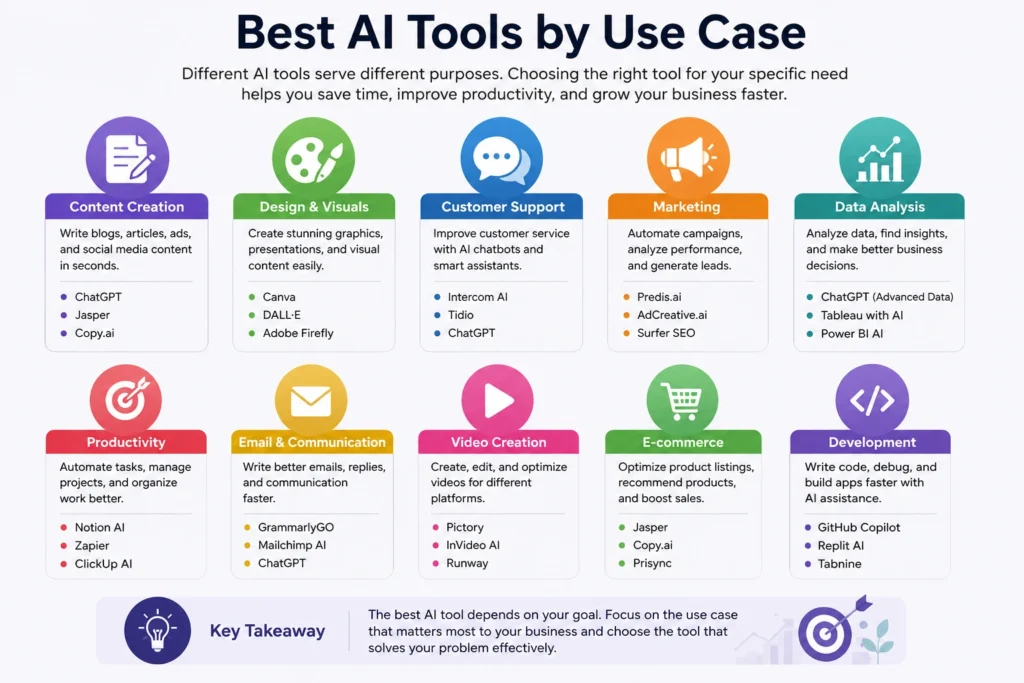
Different businesses require different AI solutions depending on their industry, team size, and operational goals. A marketing agency may prioritize content generation and automation, while an e-commerce business may focus on customer support and analytics. Recent research suggests that businesses achieve the highest ROI when they implement AI to solve specific operational problems rather than adopting technology broadly. Understanding your primary business objectives helps narrow your options and increases the likelihood of successful AI implementation and measurable business outcomes.
👉 You might also like: Best Productivity Software in 2026 | Top Tools to Boost Efficiency
Content Creation and Marketing
Businesses that rely heavily on content marketing benefit most from AI writing, design, and research tools. Platforms like ChatGPT, Jasper AI, Canva Magic Studio, and Perplexity AI help create blogs, social media posts, advertising campaigns, visual content, and market research faster while maintaining quality and consistency across marketing channels.
Productivity and Collaboration
Small teams often struggle with productivity and information management. Tools like Notion AI, ChatGPT, and Otter.ai simplify documentation, meeting management, internal communication, and knowledge sharing. These solutions help employees spend less time on administrative work and more time on strategic activities.
Automation and Operations
Businesses looking to scale efficiently frequently invest in workflow automation tools. Zapier AI enables companies to automate repetitive tasks across multiple applications, reducing manual work and improving operational consistency. Automation remains one of the fastest ways for small businesses to achieve measurable returns from AI investments.
Pros and Cons of AI Tools
Artificial intelligence provides substantial advantages for small businesses, but successful adoption requires understanding both its benefits and limitations. Recent studies show that businesses using AI strategically often experience improvements in productivity, operational efficiency, and revenue growth. However, challenges such as implementation costs, employee training, inaccurate outputs, and integration complexity can affect results. The most successful businesses treat AI as a business tool that supports employees rather than replacing them entirely.
Pros
- Improves productivity and operational efficiency
- Reduces repetitive manual tasks
- Lowers operational costs over time
- Enhances customer experiences
- Supports business growth and scalability
- Provides faster access to information and insights
Cons
- Initial learning curve and implementation time
- Subscription costs can increase quickly
- AI-generated content may require human review
- Data privacy and security concerns
- Integration challenges with legacy systems
- ROI can vary depending on business use cases
How to Choose the Right AI Tool
Selecting the right AI platform depends on your business goals, budget, workflow requirements, and long-term growth strategy. Industry research shows that businesses that begin with clearly defined objectives achieve better outcomes than those adopting AI solely because of market trends. Instead of evaluating dozens of tools simultaneously, business owners should identify one critical operational challenge and select a platform specifically designed to solve it. This focused approach reduces costs, improves adoption rates, and increases the likelihood of achieving measurable business value.
Define Your Business Goals
Before investing in any AI solution, identify the business problem you want to solve. Whether your goal is improving marketing performance, reducing support costs, automating operations, or increasing productivity, having a clear objective helps eliminate unnecessary tools and improves implementation success rates.
Compare Features and Pricing
Not every business requires enterprise-level AI software. Compare available features, pricing models, and expected business outcomes to determine which solution offers the best value. Starting with affordable plans allows businesses to test performance before making larger investments.
Check Integrations and Security
The best AI tools integrate smoothly with existing software while maintaining strong security standards. Businesses should evaluate integration capabilities, data privacy policies, compliance certifications, and access controls before implementing any AI platform into critical business workflows.
Test Before You Invest
Most leading AI platforms offer free plans or trial periods. Testing multiple solutions before committing helps businesses evaluate usability, performance, and potential ROI. Small pilot projects often produce better long-term results than large-scale AI deployments launched without validation.
Free vs. Paid AI Tools
One of the biggest questions small business owners face is whether free AI tools are sufficient or if paid subscriptions provide better value. Free AI tools are excellent for testing features, learning workflows, and handling basic tasks such as content generation, research, and design. However, paid plans typically offer higher usage limits, advanced automation, better integrations, stronger security features, and priority support. For most small businesses, the ideal approach is to start with free plans, evaluate performance, and upgrade only when business growth and operational requirements justify the investment.
Common AI Adoption Mistakes
Although AI offers significant benefits, many small businesses fail to achieve expected results because of poor implementation strategies. One of the most common mistakes is adopting too many AI tools simultaneously without clear business objectives. Other challenges include inadequate employee training, unrealistic expectations, insufficient data security planning, and failure to measure return on investment. Successful businesses typically start with a single use case, evaluate performance carefully, and gradually expand their AI capabilities based on measurable outcomes and long-term business goals.
Future of AI for Small Businesses
Artificial intelligence will continue transforming small businesses over the next decade. Emerging technologies such as AI agents, autonomous workflows, predictive analytics, and personalized customer experiences are expected to become increasingly accessible and affordable. Businesses that adopt AI strategically today will likely gain significant competitive advantages in the future. Rather than replacing human employees entirely, next-generation AI tools will function as intelligent assistants that enhance productivity, creativity, and decision-making. As AI technology advances, small businesses will have more opportunities than ever to innovate and scale efficiently.
Frequently Asked Questions (FAQs)
Which AI Tool Is Best for Small Businesses?
ChatGPT is one of the best all-around AI tools for small businesses due to its versatility, affordability, and ability to support content creation, research, customer communication, and productivity tasks.
Are AI tools worth it for small businesses?
Yes. AI tools can help small businesses save time, reduce operational costs, improve customer experiences, and increase overall productivity when implemented strategically.
Can small businesses use AI for free?
Yes. Many AI platforms, including ChatGPT, Perplexity AI, Canva, and Notion AI, offer free plans that are suitable for beginners and small teams.
Which AI tool is best for marketing?
Jasper AI and ChatGPT are among the best options for marketing because they help create content, optimize campaigns, and improve customer engagement.
What is the best AI tool for automation?
Zapier AI is one of the leading automation platforms, allowing businesses to automate workflows across thousands of applications without coding.
Are AI tools secure for business use?
Most reputable AI platforms offer encryption, access controls, and compliance features, but businesses should always review security and privacy policies before adoption.
How Much Should Small Businesses Expect to Spend on AI Tools?
Many AI tools start between $10 and $30 per month, while several platforms also provide free plans with limited features.
Can AI replace employees in small businesses?
AI is primarily designed to automate repetitive tasks and improve productivity. Human employees remain essential for creativity, strategy, and relationship-building.
Conclusion
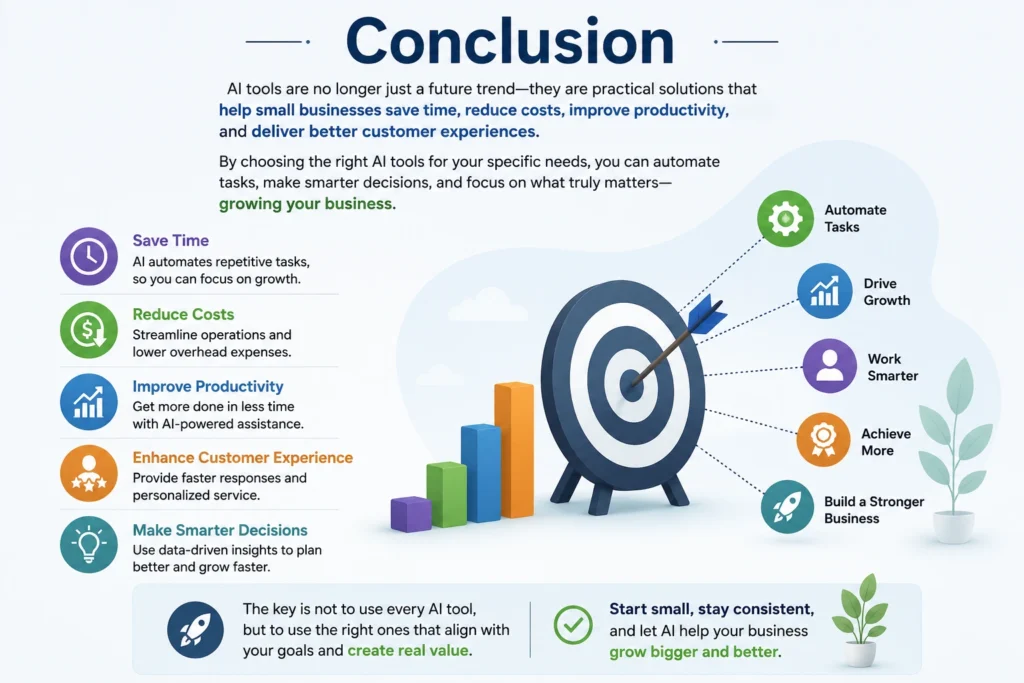
Artificial intelligence is no longer a future technology; it’s a practical business solution that helps small businesses improve efficiency, reduce costs, and accelerate growth. The key to success is choosing AI tools that align with your specific business goals rather than adopting every new platform available. Whether you need help with content creation, automation, customer support, or productivity, the right AI tools can provide measurable value and create a strong foundation for long-term business success.
✨ Got value? Let’s keep the momentum, follow Dympigal