

Printer Technology Overview
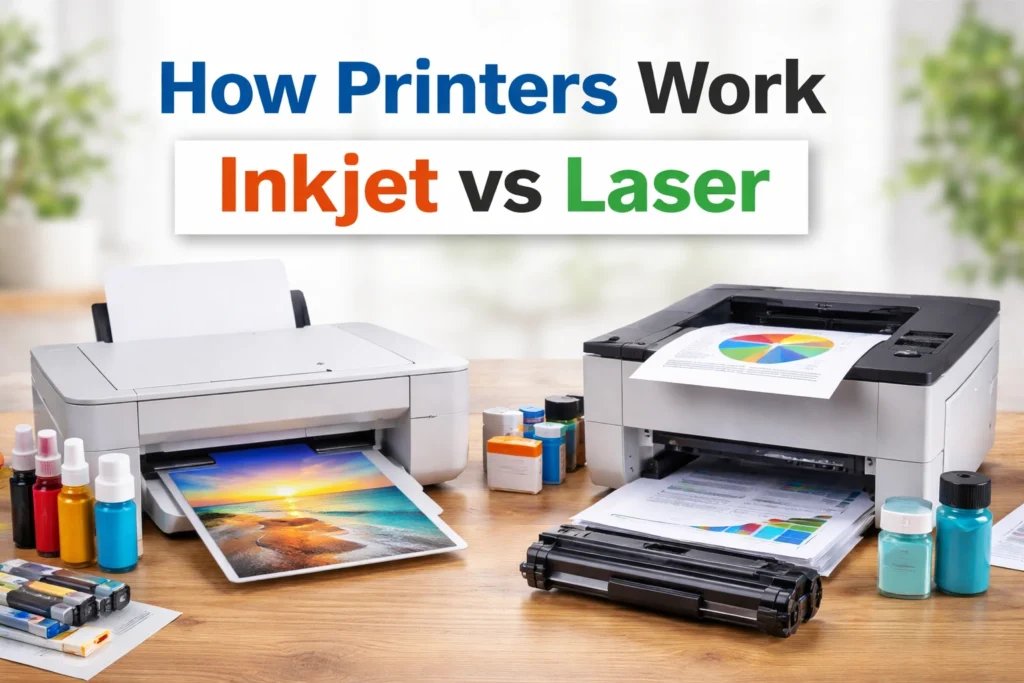
Printers are one of the most common output devices used in homes, schools, and offices. They convert digital files into physical documents by transferring text and images onto paper. Over the years, printing technology has evolved significantly, making printers faster, more precise, and more efficient. Two of the most widely used technologies today are inkjet and laser printing. Each technology follows a different mechanism to produce prints, but both aim to deliver clear and accurate results. Understanding the basics of printer technology helps users choose the right device for their needs, whether they want high-quality photo prints, everyday documents, or fast office printing.
How Printers Work
At a basic level, printers work by translating digital data from a computer into a physical image on paper. When you send a print command, the printer receives the file and processes the information through its internal controller. The device then uses a specific printing method, such as spraying ink or applying toner, to create the final output. Modern printers contain multiple components that work together, including the print engine, paper feed system, and image processing unit. These components coordinate precisely to ensure the text and graphics appear exactly as intended. While the process happens quickly, it involves complex technology operating in perfect synchronization.
👉 You might also like: Transform Your Home: Expert Paint Color Ideas
Inkjet Printing Technology
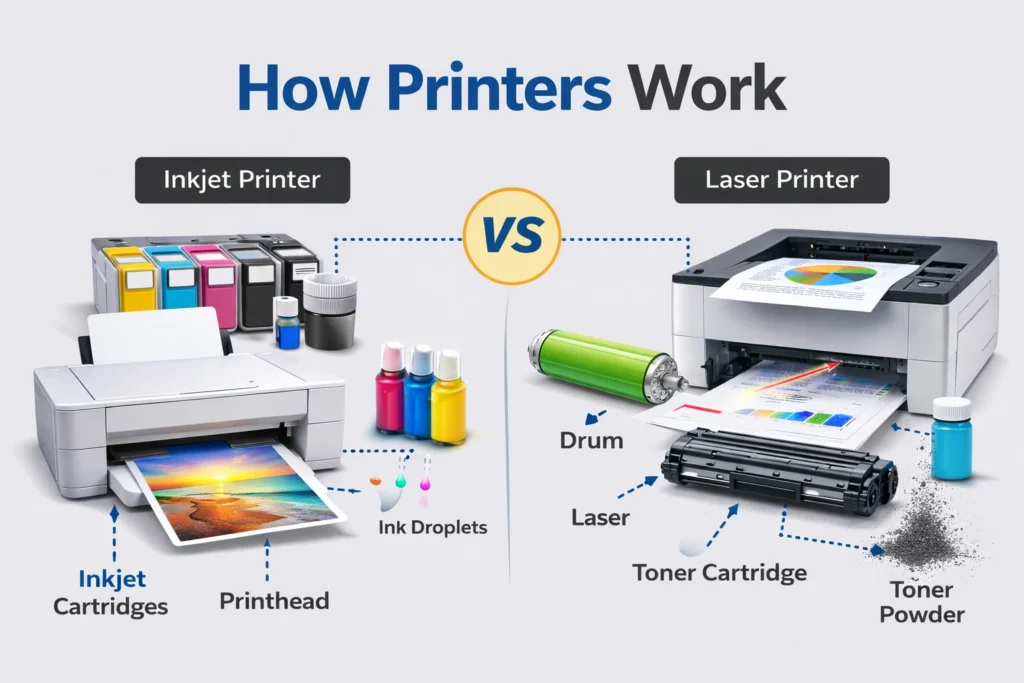
Inkjet printing is one of the most widely used printing technologies, especially for home and small office environments. This method works by spraying extremely tiny droplets of liquid ink directly onto the surface of paper. Because the droplets are so small, inkjet printers can produce detailed images and vibrant colors, making them ideal for photos and graphics. Inkjet printers typically use cartridges filled with different ink colors, such as cyan, magenta, yellow, and black. By combining these colors in precise patterns, the printer can reproduce a wide range of shades and tones. This technology is known for its versatility and relatively affordable upfront cost.
Ink Cartridge & Printhead System
The ink cartridge and printhead system are the core components of an inkjet printer. Cartridges store the liquid ink, while the printhead contains microscopic nozzles that control how the ink is released. When printing begins, the printhead moves rapidly across the page, ejecting precise droplets of ink. Each nozzle is carefully controlled to ensure accurate placement of color and detail.
Inkjet Printing Process
The inkjet printing process involves a sequence of coordinated steps that transform digital information into printed output. First, the printer receives the file and converts it into a format the print engine can understand. The paper is then fed into position while the printhead moves back and forth across the page. During this movement, the printer ejects tiny droplets of ink through microscopic nozzles. These droplets land on the paper in precise patterns to form letters, shapes, and images. Because the droplets are extremely small, the final result appears smooth and detailed. This process allows inkjet printers to produce high-quality color prints and realistic photographs.
Micro Ink Droplet Mechanism
Inkjet printers rely on a microdroplet mechanism to deliver precise ink placement. Inside the printhead, tiny heating elements or piezoelectric crystals create pressure that pushes ink through microscopic nozzles. Each droplet is carefully controlled in size and direction, allowing the printer to place thousands of droplets per second and produce sharp text and smooth images.
Inkjet Printer Pros
Inkjet printers are popular because they offer excellent versatility and strong color performance. One of their biggest advantages is the ability to produce high-quality images and photo prints with rich detail and smooth gradients. These printers are also relatively affordable compared to many other printing technologies, making them accessible for home users, students, and small offices. Inkjet printers are typically compact and easy to set up, which makes them convenient for everyday use. They can handle different media types such as photo paper, glossy sheets, and labels. For users who prioritize color accuracy and creative printing tasks, inkjet printers often provide a flexible and reliable solution.
Inkjet Printer Cons
Despite their advantages, inkjet printers also have several limitations that users should consider. One of the most common drawbacks is the cost of ink cartridges, which can become expensive over time, especially for frequent printing. Ink can also dry out if the printer is not used regularly, leading to clogged printheads and maintenance issues. Inkjet printers are generally slower than laser printers when handling large volumes of documents, which may reduce productivity in busy office environments. Additionally, printed pages can sometimes smudge if the ink has not fully dried. These factors make inkjet printers better suited for occasional or moderate printing rather than heavy daily workloads.
Laser Printing Technology
Laser printing technology is widely used in professional environments because it is designed for speed, efficiency, and consistent quality. Unlike inkjet printers that spray liquid ink, laser printers use powdered toner and a focused laser beam to create images on paper. The process involves an electrically charged drum that attracts toner particles and transfers them onto the page. Heat and pressure are then applied to permanently fuse the toner onto the paper surface. This method allows laser printers to produce sharp text and clean graphics with high precision. Because of their reliability and performance, laser printers are commonly used in offices that require frequent document printing.
Toner, Drum & Laser System
The toner, drum, and laser system are the core components that power a laser printer. Toner is a fine powder that forms the printed image, while the drum carries an electrostatic charge that attracts the toner particles. The laser beam scans across the drum surface, creating a pattern that matches the document being printed. This precise interaction ensures accurate and consistent output.
Laser Printing Process
The laser printing process is a carefully coordinated sequence that produces fast and accurate results. When a print job begins, the printer processes the digital file and converts it into a printable image pattern. A laser beam then scans across a rotating drum, creating an electrostatic image that matches the content of the document. The charged sections of the drum attract the toner powder, which is then carefully transferred onto the paper as it passes through the printer. Finally, the paper passes through heated rollers known as a fuser, which melts the toner and bonds it permanently to the page, producing durable and professional-looking prints.
Electrostatic Imaging Method
Laser printers rely on an electrostatic imaging method to form images before printing. The drum inside the printer receives an electrical charge, and the laser selectively removes portions of that charge to create a pattern. Toner particles stick to the charged areas and are transferred to the paper. This technique allows laser printers to create highly accurate text and graphics quickly.
Laser Printer Pros
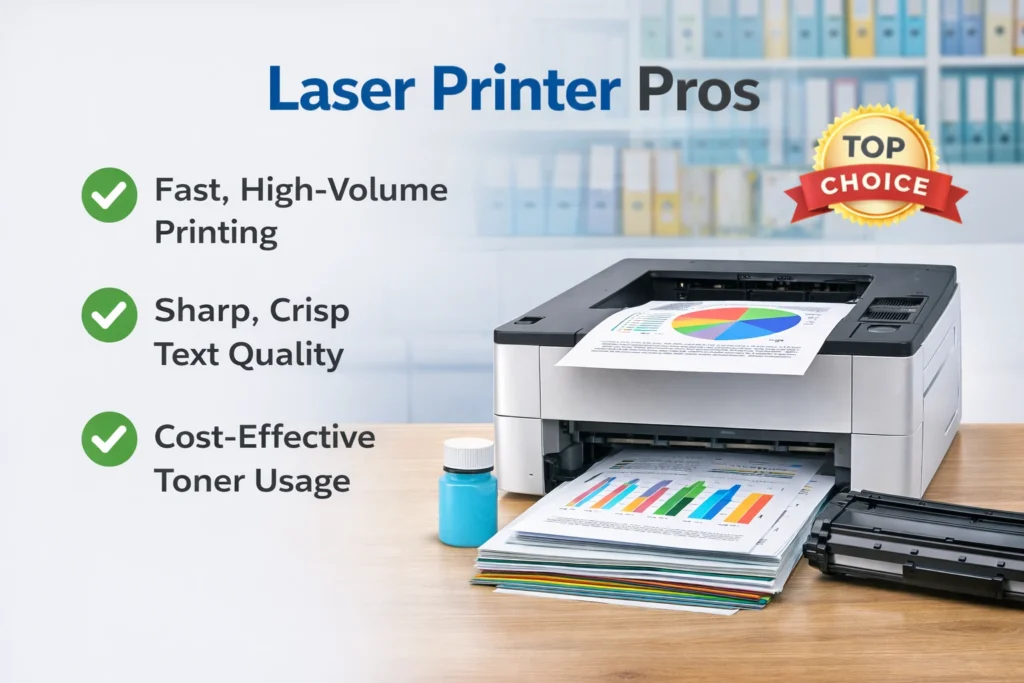
Laser printers are known for their speed, efficiency, and reliability, which makes them a preferred choice in many offices and workplaces. One of the main advantages of laser printers is their ability to print large volumes of documents quickly without sacrificing clarity. The toner used in laser printers is also more efficient than liquid ink, allowing users to print thousands of pages before replacing the cartridge. Laser printers produce extremely sharp text, making them ideal for reports, contracts, and professional documents. Another benefit is that toner does not dry out like ink, so the printer can sit unused for long periods and still perform reliably when needed.
👉 You might also like: Gramhir.pro AI Image Generator Review (2026) – Expert Guide
Laser Printer Cons
Although laser printers offer many advantages, they also come with a few drawbacks that users should consider. The initial purchase price of a laser printer is usually higher than that of an inkjet printer, which may not be ideal for users with a limited budget. Color laser printers can be especially expensive compared to standard inkjet models. Another limitation is that laser printers are generally less effective at producing high-quality photo prints because toner does not blend colors as smoothly as liquid ink. In addition, laser printers are often larger and heavier, which may require more workspace in a home or office setup.
Inkjet vs Laser: Key Differences
These Inkjet and laser printers use completely different technologies to produce printed pages, and these differences affect performance, cost, and print quality. Inkjet printers spray tiny droplets of liquid ink onto paper, which allows them to create detailed images and vibrant colors. Laser printers, on the other hand, use a laser beam and powdered toner to form text and graphics through an electrostatic process. Because of these different mechanisms, inkjet printers are typically better for photo printing and color-rich documents, while laser printers excel at fast, high-volume document printing. Understanding these differences helps users choose the printer that best fits their printing habits and priorities.
Speed, Cost & Print Quality
When comparing inkjet and laser printers, speed, cost, and print quality are the most important factors. Laser printers are usually much faster and better suited for printing large batches of documents. Inkjet printers generally have a lower upfront cost but may require more frequent cartridge replacements. In terms of quality, inkjet printers are often better for photos and colorful graphics, while laser printers produce sharper text.
Choosing the Right Printer
Choosing the right printer depends largely on how you plan to use it. If your primary goal is to print photos, creative materials, or colorful images, an inkjet printer is often the better option because it delivers strong color accuracy and smooth gradients. However, if you regularly print large volumes of text documents, a laser printer can save time and reduce long-term printing costs. Consider factors such as printing frequency, budget, and available workspace before making a decision. By understanding how each technology works and what it does best, you can select a printer that perfectly matches your needs and provides reliable performance for years.
Conclusion
Understanding how printers work can make it much easier to choose the right device for your personal or professional needs. Both inkjet and laser printers use different technologies to produce printed documents, yet each offers unique advantages. Inkjet printers are known for their ability to deliver vibrant colors and detailed images, making them ideal for photos, graphics, and creative projects. Laser printers, on the other hand, are designed for speed, efficiency, and high-volume document printing, which is why they are commonly used in offices and workplaces.
When deciding between the two, it is important to consider factors such as printing frequency, cost per page, print quality, and overall performance. By evaluating these aspects carefully, users can select a printer that aligns with their specific requirements. Ultimately, both inkjet and laser printers continue to evolve with improved technology, providing reliable and efficient solutions for modern printing needs.
✨ Got value? Let’s keep the momentum, follow Dympigal