

How E-Book Readers Work
E-Book Readers: A Technical Overview
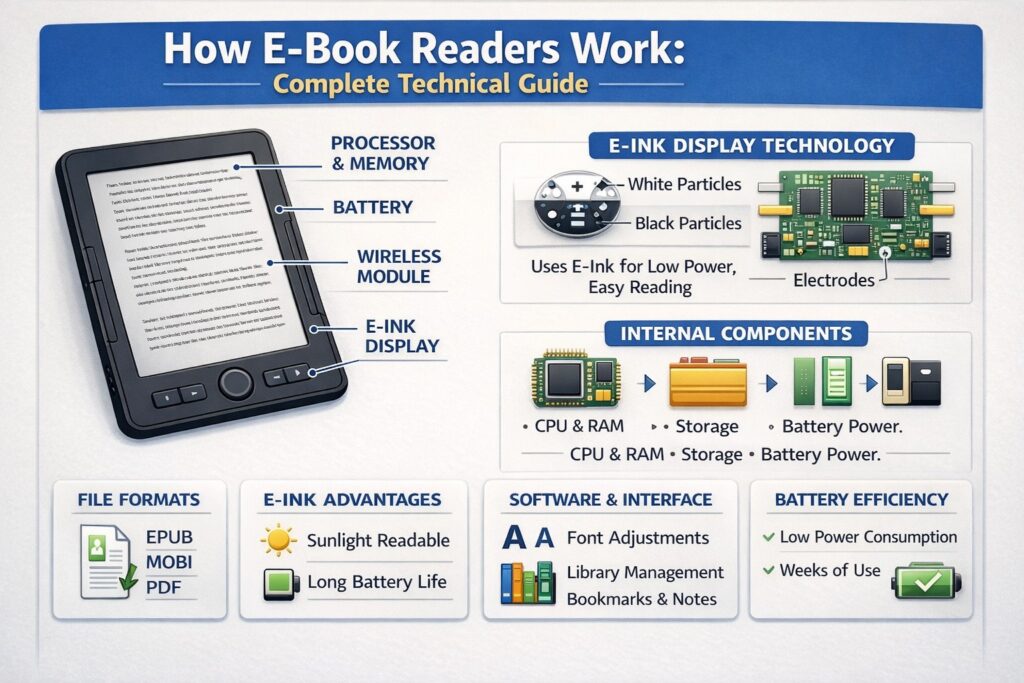
E-book readers are purpose-built digital devices designed specifically for long-form reading. Unlike tablets or smartphones, they focus on delivering a distraction-free experience that closely mimics printed paper. At their core, these devices combine low-power display technology, lightweight operating systems, and optimized file rendering engines to display digital books efficiently. When you open an e-book, the device decodes the file structure, formats the content for its screen size, and renders text in a highly readable layout. The entire system is engineered to maximize comfort, minimize eye strain, and extend battery life for weeks rather than hours.
Device Architecture & Core Hardware
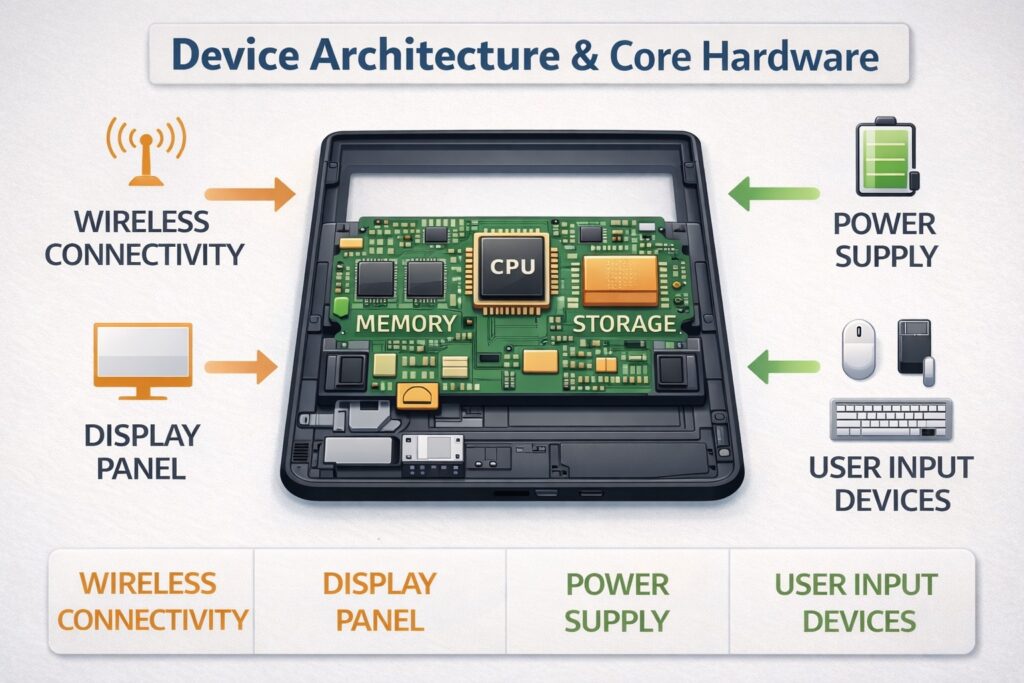
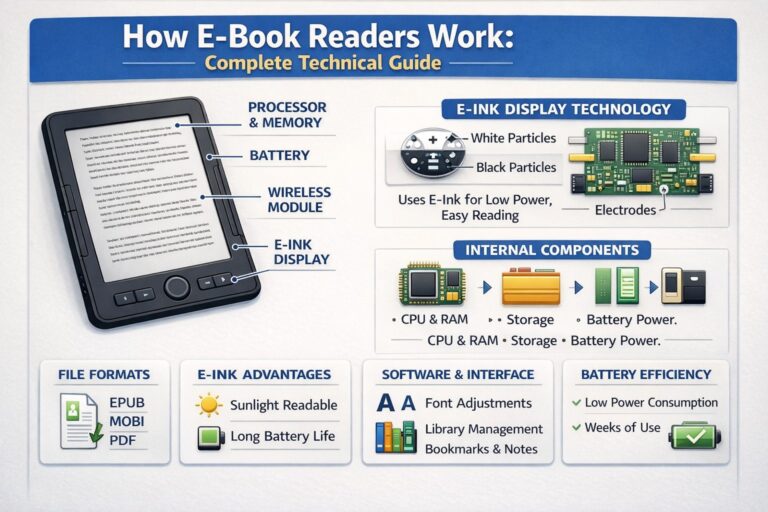
Under the hood, an e-book reader is built around a streamlined hardware architecture. It typically includes a low-frequency processor, flash storage for book files, RAM for temporary data handling, and a high-contrast display module. Unlike multimedia devices, it does not require powerful GPUs or heavy cooling systems. Instead, the hardware is optimized for page rendering and low energy consumption. Touch-sensitive layers, front-light systems, and wireless chips are integrated without compromising efficiency. This focused architecture ensures smooth page turns, stable performance, and reliable operation even with thousands of stored titles.
👉 You might also like: Gramhir.pro AI Image Generator Review (2026) – Expert Guide
E-Ink Display Mechanics
The defining feature of most e-book readers is the E-Ink display. Unlike traditional LCD or OLED screens, E-Ink uses electrophoretic technology to simulate the appearance of real ink on paper. The display contains millions of microcapsules filled with charged black and white particles. When an electric field is applied, these particles rearrange to form text and images. Because power is only used when changing the display, not maintaining it, battery consumption remains extremely low. The result is a glare-free, paper-like experience that performs exceptionally well even in direct sunlight.
Electrophoretic Microcapsule Technology
Inside an E-Ink screen, each pixel consists of microscopic capsules containing positively charged white particles and negatively charged black particles suspended in fluid. When voltage is applied, the particles move to the top or bottom of the capsule, forming visible text. This physical movement creates stable images that remain on-screen without continuous power. That stability is the key to its remarkable efficiency.
Refresh Cycles & Ghosting Control
Because E-Ink relies on particle movement, occasional full-screen refreshes are required to prevent residual images, often called ghosting. Modern devices use advanced waveform controllers to optimize refresh timing and reduce visual artifacts. Partial refresh modes allow faster page transitions while maintaining clarity. These improvements make modern e-book readers feel smoother and more responsive than earlier generations.
Embedded Processing & Memory Systems
Although e-book readers appear simple, they rely on embedded processing systems that manage file decoding, font rendering, indexing, and user preferences. The processor interprets structured e-book files, converts markup into readable layouts, and adjusts formatting dynamically. Internal flash storage holds thousands of books, while RAM supports real-time operations such as search and annotations. Because the workload is focused and predictable, the system remains highly efficient. This balance between lightweight processing and smart memory management ensures fast navigation without unnecessary power drain.
E-Book File Structures & Rendering
E-books are not just digital pages; they are structured files built with markup languages such as HTML and CSS wrapped inside standardized containers like EPUB. When you open a file, the reader’s rendering engine parses its structure, applies styling rules, and adapts the layout to your screen size and chosen font. This dynamic reformatting process is known as reflow. Advanced rendering engines also handle embedded images, metadata, hyperlinks, and interactive elements while preserving readability across different display resolutions.
Reflow Engines vs Fixed Layout Parsing
Reflow engines automatically adjust text size and spacing based on user preferences, making reading flexible and accessible. In contrast, fixed-layout formats preserve exact positioning, which is useful for graphic-heavy books. The reader’s software determines how to interpret each format, ensuring compatibility and maintaining structural integrity without breaking the visual flow.
DRM & Content Protection Frameworks
Digital Rights Management (DRM) is the security layer that protects copyrighted e-books from unauthorized distribution. When you purchase a book, you’re typically buying a license to access it rather than full ownership of the file. DRM systems encrypt the content and link it to your device or account. The e-book reader verifies authentication before allowing access, ensuring the file cannot be freely copied or shared. While DRM protects publishers and authors, it can also affect compatibility across devices. Modern readers balance security with usability, aiming to protect intellectual property without disrupting the reading experience.
Wireless Sync & Cloud Integration
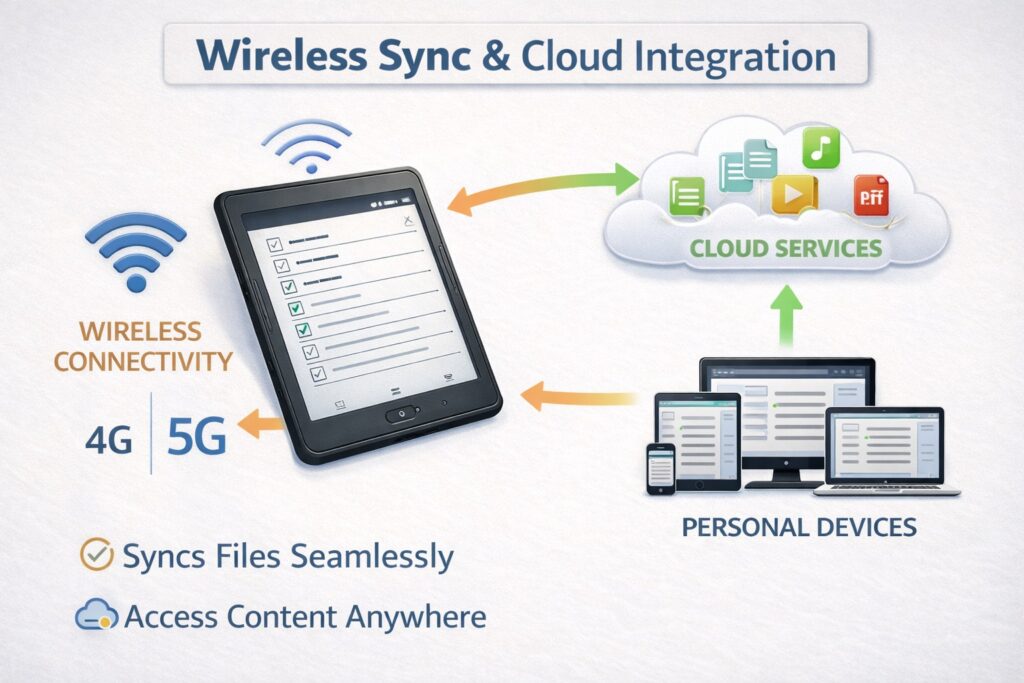
Modern e-book readers rely heavily on wireless connectivity to deliver seamless access to digital libraries. Built-in Wi-Fi modules allow users to download books instantly, sync reading progress, and back up highlights or notes. Cloud integration ensures that your content remains accessible across multiple devices linked to the same account. When you switch devices, your last read page automatically updates. Behind the scenes, secure servers manage authentication, file delivery, and data synchronization. This infrastructure transforms the e-reader from a standalone gadget into a connected reading ecosystem.
👉 You might also like: How Fitness Bands Count Steps & Calories | Expert Guide
Server Authentication & Content Delivery
When you download an e-book, the device communicates with a secure server that verifies your account credentials. After authentication, encrypted files are transmitted through a content delivery network to ensure fast and stable downloads. This system minimizes latency and protects sensitive data. The process happens within seconds, making digital book access nearly instantaneous.
Power Optimization & Battery Logic
One of the most impressive aspects of e-book readers is their exceptional battery life. Unlike smartphones that constantly refresh displays and run background apps, e-readers consume power only during specific operations such as page turns, wireless downloads, or screen refreshes. The E-Ink display plays a major role in conserving energy, as it requires power only when updating content. Low-frequency processors and optimized firmware further reduce consumption. Advanced sleep modes suspend unnecessary processes when the device is idle. This intelligent power management allows many e-readers to operate for weeks on a single charge.
UX Design & Interaction Model
The user experience of an e-book reader is intentionally minimal and reading-focused. The interface eliminates distractions like notifications and background apps. Navigation is built around simple gestures such as tapping or swiping to turn pages. Menu systems are streamlined, allowing quick access to libraries, settings, and bookmarks. Designers prioritize readability by offering adjustable font sizes, margin controls, and lighting options. The interaction model is engineered for long reading sessions, reducing cognitive load and eye fatigue. Everything about the interface supports immersion, making digital reading feel natural and uninterrupted.
Adaptive Typography & Accessibility Layers
Modern e-readers incorporate adaptive typography engines that adjust font weight, spacing, and contrast for optimal clarity. Accessibility features such as text-to-speech, dyslexia-friendly fonts, and adjustable line spacing enhance usability for diverse readers. These layered customization tools ensure that digital reading is inclusive, comfortable, and tailored to individual preferences without compromising layout stability.
Performance Limits & Future Innovation
While e-book readers are highly optimized for reading, they are intentionally limited in multimedia performance. Their low-power processors are not designed for video playback, gaming, or heavy multitasking. E-Ink displays also have slower refresh rates compared to LCD screens, which restricts animation capabilities. However, innovation continues to push boundaries. Modern devices now feature color E-Ink panels, faster refresh technologies, stylus input for note-taking, and AI-powered recommendations. Future advancements may include improved contrast ratios, flexible displays, and deeper integration with cloud ecosystems. Even with limitations, e-book readers continue evolving while staying true to their reading-first philosophy.
Conclusion
At first glance, an e-book reader may appear simple. In reality, it represents a highly specialized blend of hardware efficiency, smart software engineering, and display innovation. From electrophoretic microcapsules that simulate ink to optimized rendering engines that dynamically format text, every component is designed with one goal in mind: delivering an immersive reading experience. Unlike multipurpose devices, e-book readers eliminate distractions and maximize endurance. They store thousands of titles, synchronize seamlessly across devices, and operate for weeks on a single charge.
As digital publishing continues to expand, understanding how e-book readers work reveals why they remain relevant in a world dominated by smartphones and tablets. Their intelligent simplicity, energy efficiency, and reader-focused design ensure they will continue shaping the future of long-form digital reading.
Frequently Asked Questions (FAQs)
1. How does an e-book reader display text?
It uses E-Ink technology that moves charged particles to form text, mimicking real paper without constant backlighting.
2. Do e-book readers need the internet to read books?
No, the internet is only needed to download or sync books; offline reading works anytime.
3. What file formats do e-book readers support?
Most support EPUB, PDF, and proprietary formats like AZW, depending on the brand.
4. Why does an e-book reader battery last so long?
Because E-Ink screens use power only when turning pages, not continuously like LCD screens.
5. Can I read PDFs on an e-book reader?
Yes, but formatting may vary depending on screen size and device compatibility.
✨ Got value? Let’s keep the momentum, follow Dympigal