


5 Best Web Development Tools for Modern Developers
Web Dev Tooling Ecosystem
The web development landscape has evolved dramatically over the last few years, with tools now more powerful, collaborative, and intelligent than ever. Modern developers rely on an ecosystem of software that streamlines coding, debugging, design, testing, and deployment. Understanding this ecosystem is crucial because it determines how efficiently you can turn ideas into functional, user-friendly websites or applications. From lightweight code editors to full-fledged version control platforms, the right combination of tools enables faster development cycles, cleaner code, and better collaboration, whether you’re working solo or in a team environment.
Evolution of Development Tools
Web development tools have shifted from basic text editors to intelligent, feature-rich platforms that integrate seamlessly with multiple programming languages, frameworks, and cloud services. This evolution supports not just writing code, but also design, testing, and deployment, all in one workflow. Learning the history and purpose of these tools helps developers pick the right software for their projects while staying ahead of trends. Modern tools also emphasize community support and extensibility, allowing continuous improvement and customization based on real-world feedback and industry needs.
Strategic Impact of Dev Tools
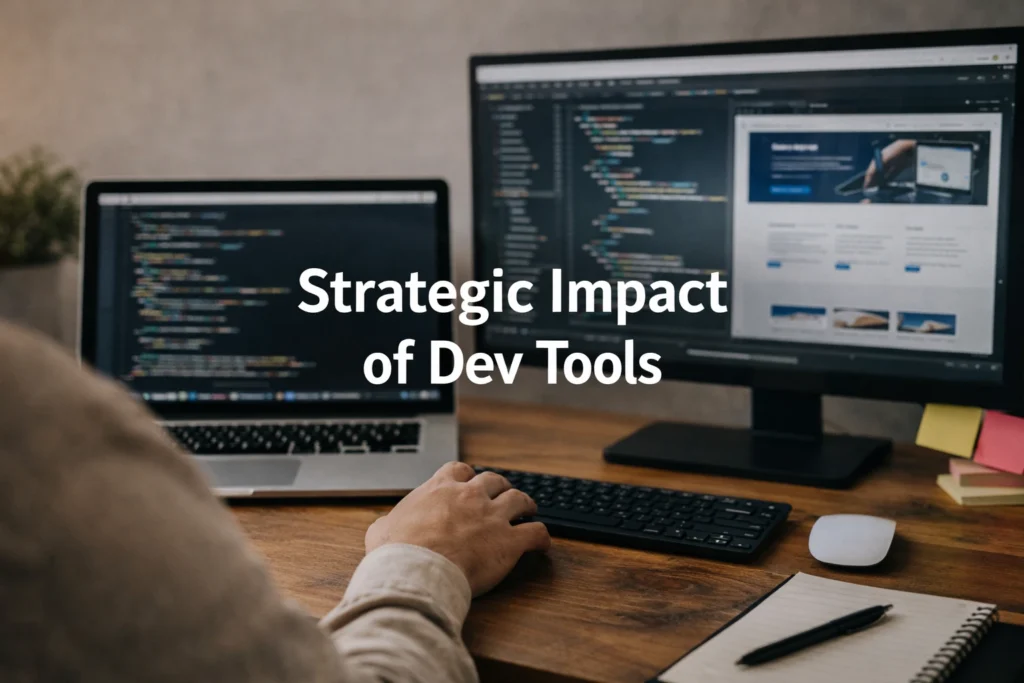
Choosing the right development tools can drastically affect productivity, code quality, and overall project success. Tools aren’t just conveniences; they shape how developers approach problems, collaborate with teams, and maintain code over time. A carefully selected toolkit streamlines workflows, reduces bugs, and enables faster prototyping, while outdated or poorly chosen tools can slow development and create frustration. Beyond speed, strategic tools also impact maintainability, scalability, and even long-term career growth, as proficiency with widely used tools is often a key factor in hiring decisions across tech companies.
👉 You might also like: Home Pipe Replacement | Cost & Expert Guide
Efficiency & Workflow Impact
Every modern web developer knows that time is a critical resource. Efficient tools reduce repetitive tasks, automate mundane work, and provide intelligent suggestions that cut down errors. From debugging support in IDEs to automated testing frameworks, using the right tools directly improves workflow efficiency. Teams benefit as well; standardized toolsets simplify collaboration, version control, and code reviews. Ultimately, a well-chosen toolset isn’t just about saving time; it ensures developers can focus on creating high-quality, innovative solutions rather than getting bogged down by technical friction.
Advanced Tool Selection Framework
Selecting the perfect web development tools isn’t random; it requires a framework that balances project requirements, team skills, and long-term adaptability. Consider criteria like language compatibility, integration with frameworks, extensibility through plugins, and community support. Also, evaluate performance, learning curve, and platform flexibility to determine whether the tool works on Windows, macOS, or Linux. Advanced developers often maintain a modular toolkit that evolves with each project, allowing them to adopt specialized tools for design, backend services, testing, and deployment. A structured selection process ensures consistency, reduces errors, and enhances productivity.
Top 5 Tools Breakdown
While hundreds of tools exist for web developers, some stand out for their versatility, reliability, and industry adoption. These top five tools, Visual Studio Code, GitHub, Figma, Bootstrap/Tailwind CSS, and Postman, cover the core aspects of modern development: coding, collaboration, design, responsive UI, and API testing. Together, they form a foundational stack that supports everything from small personal projects to enterprise-level applications. Mastering these tools equips developers to write cleaner code, maintain organized projects, streamline design workflows, and test APIs efficiently, giving them a competitive edge in today’s fast-paced development world.
VS Code – Extensible Code Environment
Visual Studio Code (VS Code) is a lightweight yet powerful code editor that has become the industry standard. Its strength lies in extensibility: developers can install thousands of plugins to support different languages, frameworks, and workflow optimizations. Features like syntax highlighting, auto-completion, integrated terminals, and Git support make coding faster and more precise. VS Code also offers real-time collaboration and debugging tools, enabling both beginners and seasoned developers to work efficiently. Its cross-platform compatibility ensures that whether you’re on Windows, macOS, or Linux, your environment remains consistent and productive.
Plugin Architecture & Customization
VS Code’s plugin ecosystem allows developers to tailor the editor to their exact workflow. From formatting tools like Prettier to live preview servers and linting extensions, each plugin enhances productivity while reducing repetitive tasks. Developers can create custom keybindings, themes, and workspace configurations to optimize their environment. This adaptability makes VS Code suitable for multiple languages and project types, whether front-end, back-end, or full-stack development, ensuring developers can work efficiently without switching between multiple tools.
GitHub – Distributed Version Control
GitHub is more than just a code repository; it’s a distributed version control and collaboration platform that has redefined how developers work together. By providing tools to manage code changes, track issues, and maintain multiple branches, GitHub ensures projects remain organized and conflict-free. Its integration with CI/CD pipelines and other development tools allows teams to automate testing, deployment, and code quality checks, making the platform essential for modern web development workflows. Whether working solo or in large teams, GitHub provides a structured environment that prevents code chaos and encourages collaboration.
Collaboration & Branch Management
GitHub’s branching and pull request system allows multiple developers to work simultaneously on different features without overwriting each other’s code. Code reviews, inline comments, and automated checks ensure high-quality contributions before merging into the main branch. Teams can also track bugs, features, and project milestones in an organized way, making development faster, transparent, and more accountable. The platform’s collaboration features have become a standard in both open-source and enterprise projects.
Figma – Collaborative Design System
Figma is a cloud-based UI/UX design tool that enables designers and developers to work together in real time. Unlike traditional design software, Figma doesn’t require local installations, making it accessible across devices and platforms. Developers can inspect elements, copy CSS, and integrate design systems directly into their workflow, bridging the gap between design and development. Its collaborative features reduce misunderstandings, ensure consistent design standards, and speed up project timelines. For teams building responsive, user-friendly interfaces, Figma has become an indispensable tool in modern web development.
Real-Time Collaboration
Figma’s standout feature is real-time collaboration, where multiple team members can view, edit, and comment simultaneously. This eliminates the back-and-forth typically seen in email or file-based workflows. Changes are automatically synced, ensuring everyone works on the latest version, which saves time and avoids miscommunication. Designers, developers, and stakeholders can contribute in a single workspace, making project handoffs smoother and more efficient.
Bootstrap vs Tailwind – Architecture Comparison
When it comes to frontend development, frameworks like Bootstrap and Tailwind CSS play a vital role in creating responsive, user-friendly websites quickly. Bootstrap offers prebuilt components, grid systems, and standardized styling, making it ideal for rapid prototyping. Tailwind CSS, on the other hand, follows a utility-first approach, giving developers precise control over design elements without overriding prebuilt styles. Choosing between them depends on project requirements: Bootstrap for faster implementation and consistency, Tailwind for highly customized, lightweight, and modern designs that scale with your application.
Responsive Design Benefits
Both frameworks simplify responsive design by providing ready-made solutions for different screen sizes. This ensures websites look great across devices without extensive custom coding. With grids, breakpoints, and pre-styled components, developers can maintain consistent layouts, accelerate development, and reduce errors. The right choice of framework improves usability, reduces design inconsistencies, and enhances overall user experience.
Postman – API Lifecycle Management

Postman is a leading platform for developing, testing, and documenting APIs, essential for modern web applications that rely on microservices and external services. It allows developers to send requests, inspect responses, and automate testing for both REST and GraphQL APIs. Postman’s environment variables, collections, and scripting features enable efficient workflow automation, making API testing more reliable and reproducible. For teams integrating multiple services, Postman ensures that communication between front-end and back-end systems remains seamless, secure, and efficient.
👉 You might also like: Novafork Guide: Features, Safety, and Streaming Insights
Automation & Testing Features
Postman’s automation features allow developers to run tests on APIs repeatedly, catch errors early, and validate performance. Tests can be scheduled, chained, and integrated with CI/CD pipelines, ensuring that APIs remain reliable as applications evolve. By simulating different scenarios, Postman helps developers identify potential bottlenecks or failures before they reach end-users, saving both time and resources.
Dev Tooling Categories
Web development tools can be broadly categorized based on their role in the development lifecycle. These include frontend frameworks, backend frameworks, code editors, version control systems, design platforms, testing tools, and deployment utilities. Each category serves a unique purpose, helping developers write cleaner code, streamline workflows, and deliver high-quality applications. Understanding these categories allows teams to assemble a balanced toolkit that addresses every stage of development. By strategically combining these tools, developers can reduce redundancy, increase productivity, and create applications that are both scalable and maintainable over time.
Frontend vs Backend Toolchains
Frontend and backend development require distinct sets of tools, yet both must integrate seamlessly for a successful project. The Frontend toolchains focus on UI/UX, responsive layouts, animations, and browser compatibility, while backend toolchains handle servers, databases, APIs, and business logic. Choosing the right combination ensures smooth data flow, faster rendering, and reliable user experiences. Modern developers often use full-stack approaches, where both frontend and backend tools are carefully selected to complement each other, making development faster, reducing errors, and improving maintainability.
AI-Driven Development Tools
Artificial intelligence is transforming web development by automating repetitive tasks, suggesting code improvements, and predicting potential bugs. Tools like GitHub Copilot or AI-based testing assistants can generate boilerplate code, detect security vulnerabilities, and even optimize algorithms. AI tools not only increase productivity but also enhance learning by providing contextual suggestions and best practices. As the industry continues to embrace AI, developers who incorporate these tools into their workflow gain a significant advantage in efficiency, accuracy, and staying ahead of evolving development trends.
Benefits of AI Integration
AI-driven tools help reduce human error, accelerate debugging, and improve overall code quality. They can handle repetitive tasks, freeing developers to focus on complex problem-solving. Teams benefit from predictive insights and automated testing, ensuring applications remain robust, secure, and performant.
Tool Selection Pitfalls
Even experienced developers make mistakes when selecting tools, often choosing solutions based on popularity rather than project fit. Common pitfalls include over-reliance on heavy frameworks, neglecting team skill levels, ignoring integration capabilities, or using tools without long-term support. These choices can lead to slower development, higher maintenance costs, and reduced scalability. Avoiding these mistakes requires careful evaluation, testing in real project scenarios, and considering both immediate needs and future growth, ensuring your toolkit enhances productivity rather than becoming a bottleneck.
Free vs Premium Tooling
While free tools offer impressive functionality, premium solutions provide advanced features, support, and integrations that can significantly enhance development efficiency. Free tools like VS Code, Figma, or GitHub free tiers are excellent for beginners and small projects. Premium versions often include enhanced collaboration, enterprise-level security, cloud integration, and AI-powered automation. Choosing between free and paid options depends on project scale, team size, and required features. A balanced approach often combines both, leveraging free tools for core work and premium tools for advanced capabilities.
Future-Ready Dev Stack
Building a future-ready web development stack means selecting tools that are scalable, flexible, and adaptable to emerging technologies. Developers should focus on modular tools that support multiple frameworks, seamless integration, cloud deployment, and AI-driven workflows. A modern stack often includes a versatile code editor, version control, responsive frameworks, API testing tools, and collaborative design platforms. By anticipating future trends and selecting tools that grow with project complexity, developers can maintain efficiency, reduce technical debt, and ensure long-term success in an ever-evolving digital landscape.
Conclusion
Mastering the right web development tools transforms how projects are executed. From coding in VS Code, managing versions in GitHub, designing in Figma, building responsive layouts with Bootstrap/Tailwind, to testing APIs in Postman, each tool serves a strategic purpose. Understanding categories, avoiding common pitfalls, embracing AI, and balancing free and premium solutions ensures developers remain productive, innovative, and future-ready. A well-curated, advanced toolkit isn’t just a convenience; it’s a competitive edge that allows developers to create robust, scalable, and high-quality web applications efficiently.
✨ Got value? Let’s keep the momentum, follow Dympigal